Introduction to Mount Athos
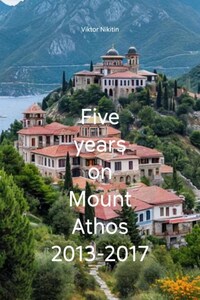
The Holy Mount Athos is a peninsula in northeastern Greece, the third and easternmost protrusion (the third "finger") of the Chalcidice peninsula, which juts out into the Aegean Sea. It is about 50 km long, 8 to 12 km wide, and covers an area of about 350 square kilometers. The peninsula is divided into twenty self-governing territories. Each territory has a governing monastery and other monastic settlements surrounding it.
Since the 1920s, the land administrative border of the Holy Mountain has been located to the east of the city of Ouranoupoli. Previously, it ran further west, along the dry bed of the Xerxes Canal, an ancient shipping canal at the narrowest point of the peninsula, built in 480 BC by order of the Persian king Xerxes I during the Greco-Persian Wars. The canal connected two gulfs of the Aegean Sea – Acanthus Gulf (now Ierissos Gulf) and Singitic Gulf (now Agion Oros Gulf). The territory of the monastic community is separated by land from the rest of Greece by a fence, about 9 kilometers long. The border runs along an imaginary line from the point of Frangokastro on the west coast to Cape Arapis on the opposite coast.
The monastic community of Mount Athos enjoys autonomy within the borders of the Athos peninsula. In the system of administrative regions of Greece, it is called the "Autonomous Monastic State of Mount Athos" and has the status of a self-governing community of 20 Orthodox monasteries, which have been under the jurisdiction of the Patriarch of Constantinople since 1312. Greece's sovereignty over the peninsula was secured by the Treaty of Lausanne in 1923. The self-government regime is based on the provisions of the first Charter of Mount Athos, approved by the Byzantine Emperor John Tzimiskes in 972 AD.
* * *
Today, the monasteries of the Holy Mountain are home to about 2,000 Orthodox monks from Greece, Serbia, Romania, Moldova, Georgia, Bulgaria, Montenegro, Ukraine and Russia. The Athonite monasteries contain a rich collection of well-preserved artifacts, rare books, ancient documents and works of art of great historical value, and Mount Athos is included in the UNESCO World Heritage List.
All persons leading monastic life on Mount Athos acquire Greek citizenship upon their admission to the monasteries as novices or monks. Although Athos, like the rest of Greece, is legally part of the European Union, the monastic institutions of the Holy Mountain have special jurisdiction. This gives their authorities the right to restrict the free movement of people and goods within their territory; in particular, the monastic community prohibits the entry of women. The main purpose is to ensure the observance of chastity and celibacy of the monastics, but also because only the Virgin Mary represents the female sex on the Holy Mountain. The ban was officially proclaimed by several emperors, including Constantine Monomachos in 1046.